Classical Conditioning: Definition, Examples, Principles, and Real-Life Applications
Learn classical conditioning with Pavlov's experiment, key terms, real-life examples, applications, and practice questions.
Have you ever heard a phone notification and reached for your phone before even checking whether the message was important? Or felt nervous when walking into a hospital because the smell, lights, or sounds reminded you of a past medical experience?
That is the basic idea behind classical conditioning: we learn to connect one thing with another.
Classical conditioning is one of the most important concepts in psychology because it explains how people and animals learn emotional and physical responses through association. It helps explain fear, food aversions, advertising effects, classroom routines, medical anxiety, and even some therapy techniques.
In simple terms, classical conditioning happens when a neutral stimulus becomes linked with something meaningful and eventually produces a learned response on its own.
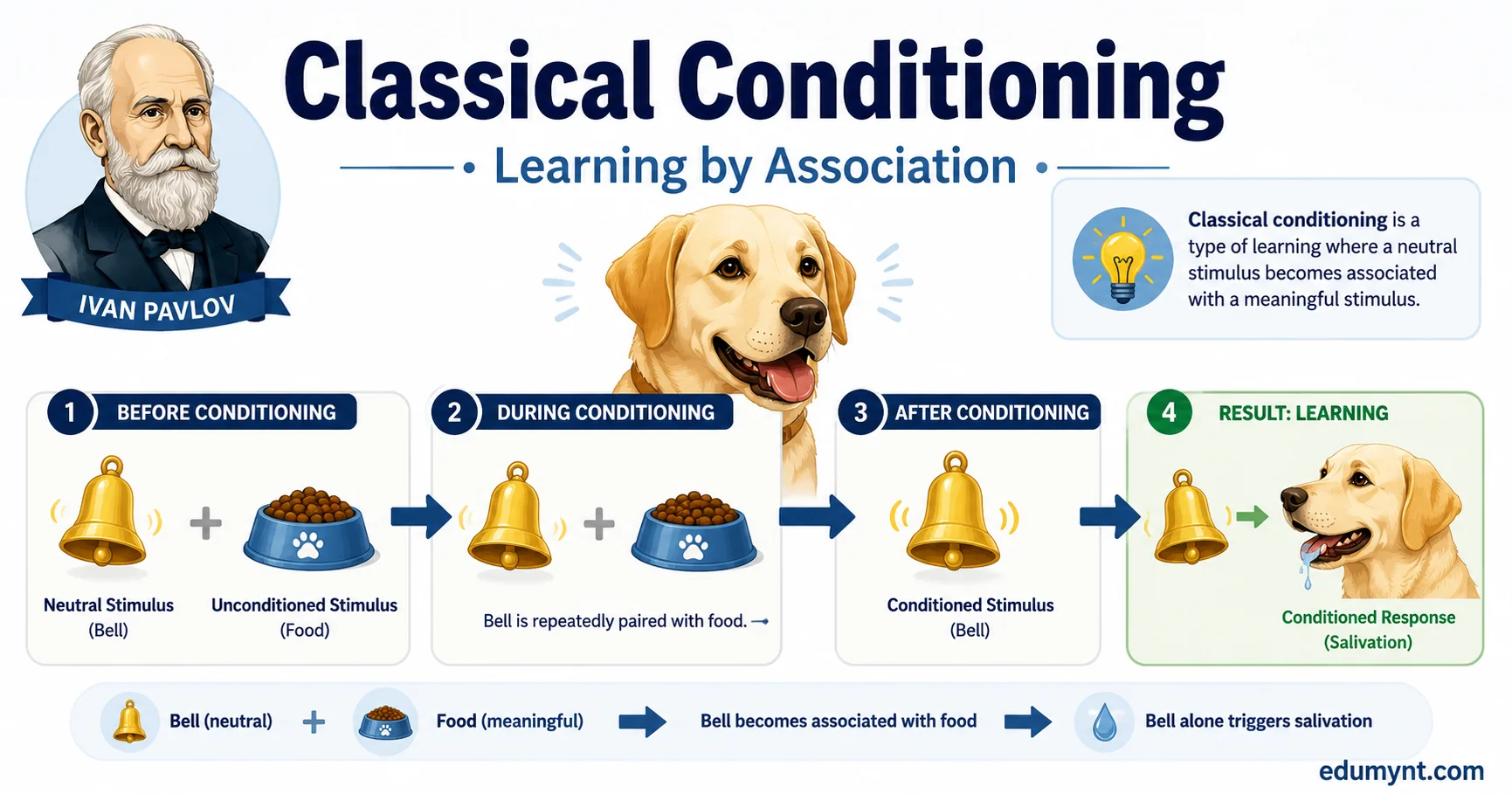
Classical conditioning is a type of learning in which a person or animal learns to associate two stimuli.
A stimulus is anything that can trigger a response. It could be a sound, smell, image, taste, place, person, or situation.
For example:
- Food naturally makes a hungry dog salivate.
- A bell does not naturally make a dog salivate.
- But if the bell is repeatedly paired with food, the dog may eventually salivate when it hears the bell alone.
That learned response is classical conditioning.
Classical conditioning is learning by association, where a previously neutral stimulus starts to produce a response after being paired with a stimulus that naturally produces that response.
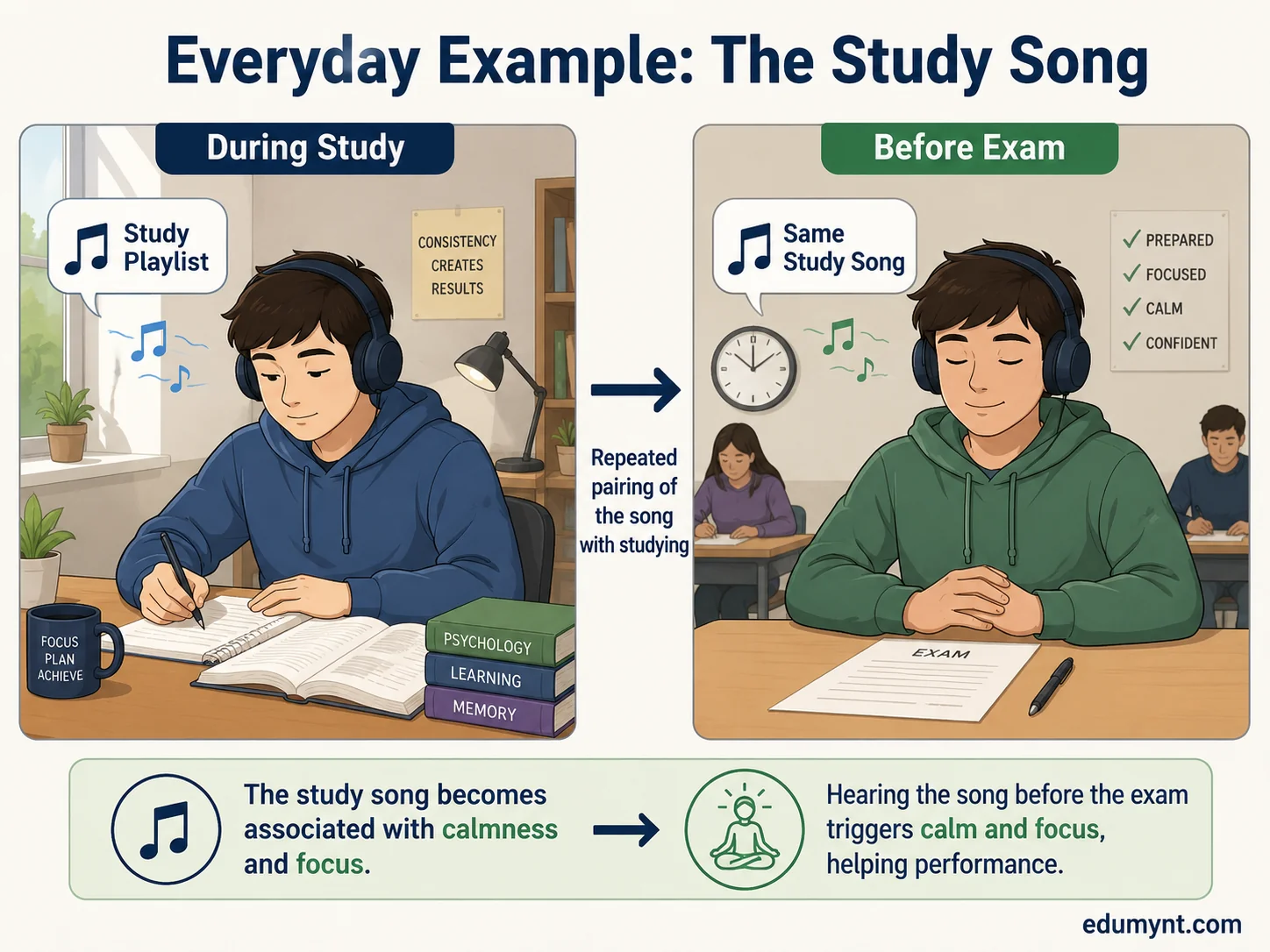
Imagine a student feels relaxed when listening to a certain song while studying. Over time, that song becomes associated with focus and calmness. Later, when the student hears the same song before an exam, they may feel more settled.
The song did not naturally create exam confidence. It became connected with a calm study routine.
The most famous example of classical conditioning comes from Ivan Pavlov, a Russian physiologist.
Pavlov was studying digestion in dogs. He noticed that dogs did not only salivate when food was placed in their mouths. They also began salivating when they saw lab assistants or heard sounds that predicted food.
This observation led to one of psychology’s most famous experiments.
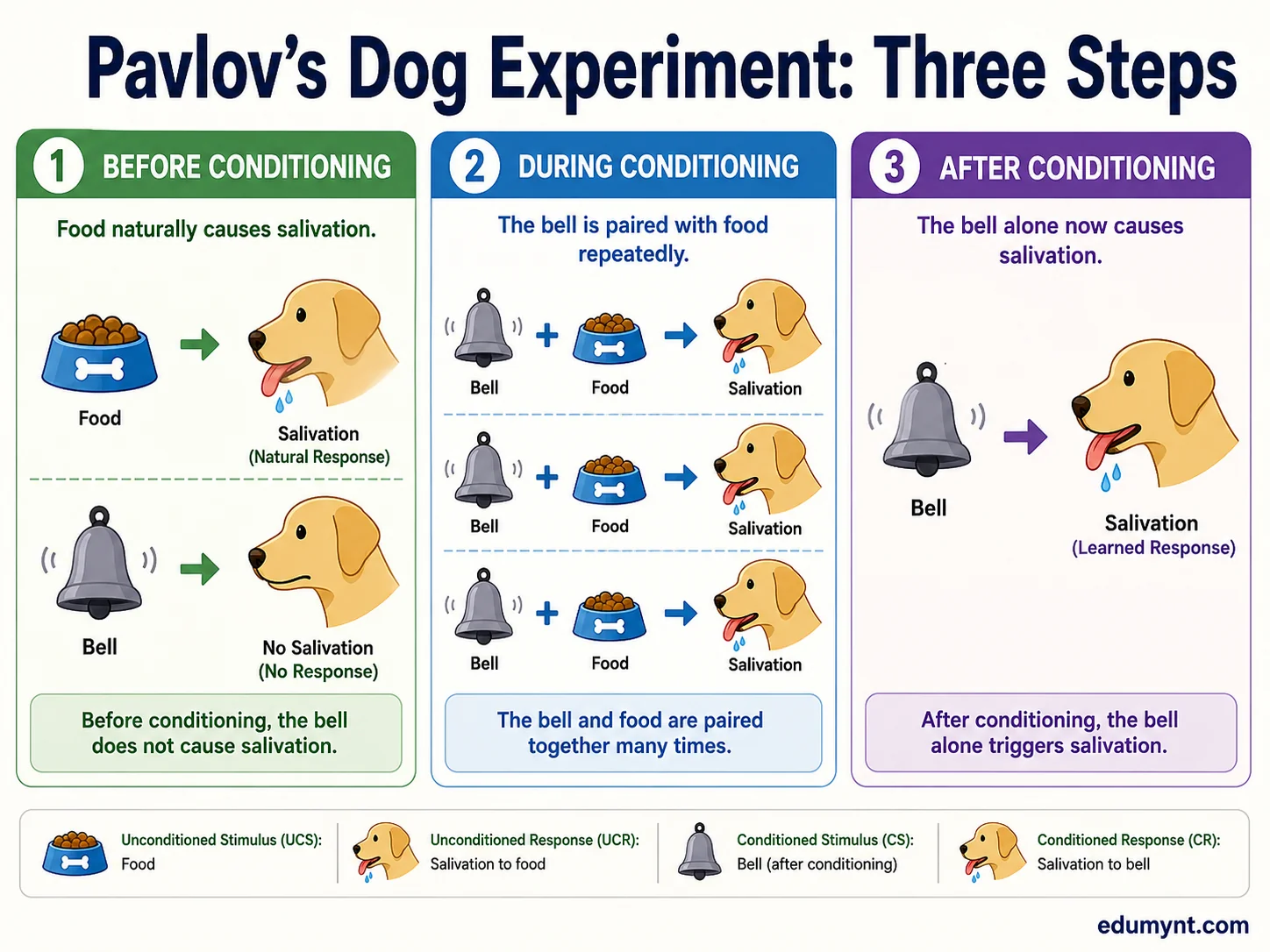
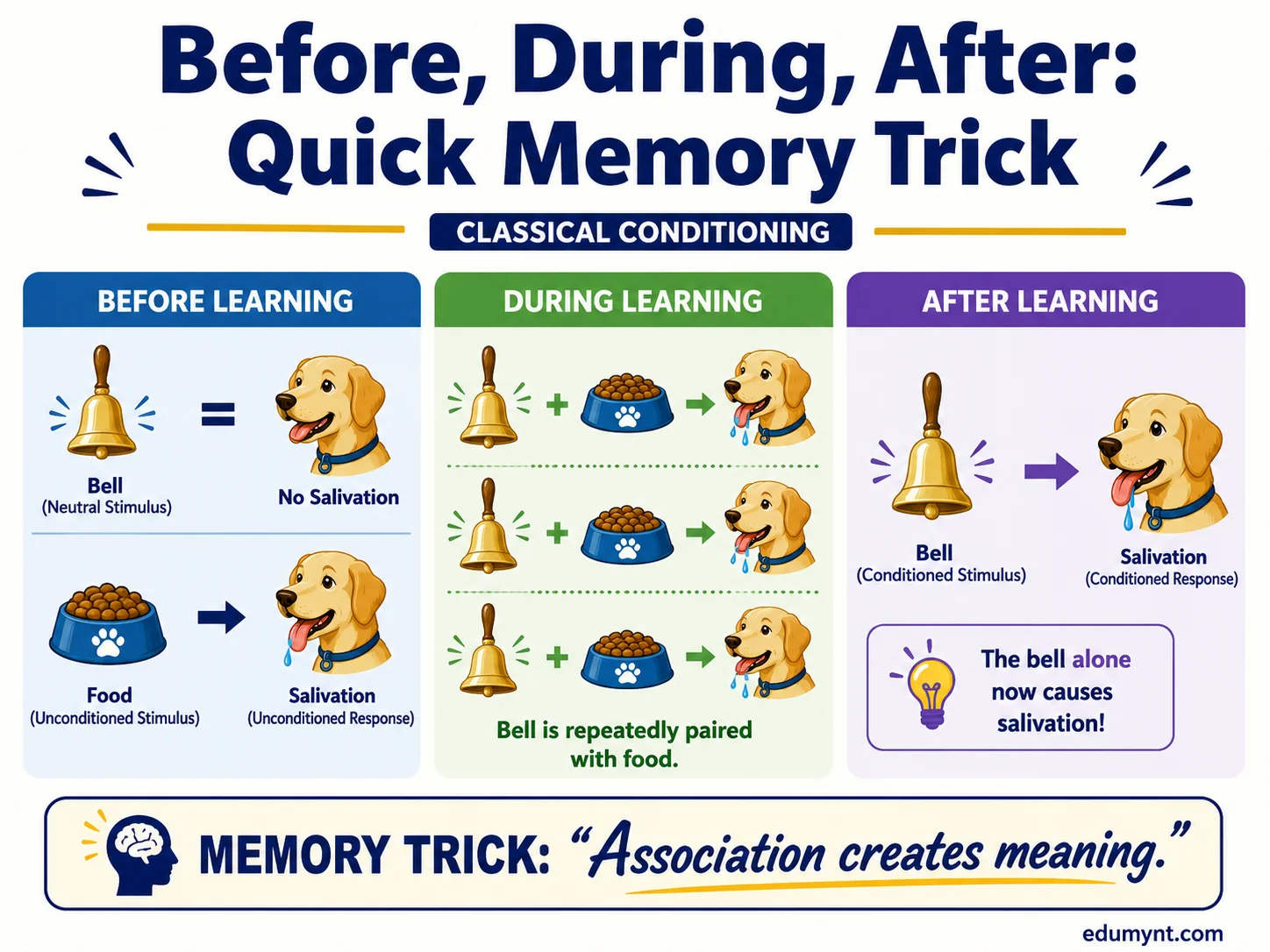
Before learning happens:
- Food naturally causes salivation.
- A bell or tone does not naturally cause salivation.
At this stage, the bell is neutral.
Pavlov repeatedly paired the bell with food.
The sequence looked like this:
Bell rings → Food appears → Dog salivates
After several pairings, the dog began to connect the bell with the arrival of food.
Eventually, the bell alone caused the dog to salivate.
Bell rings → Dog salivates
The bell had become a learned signal for food.
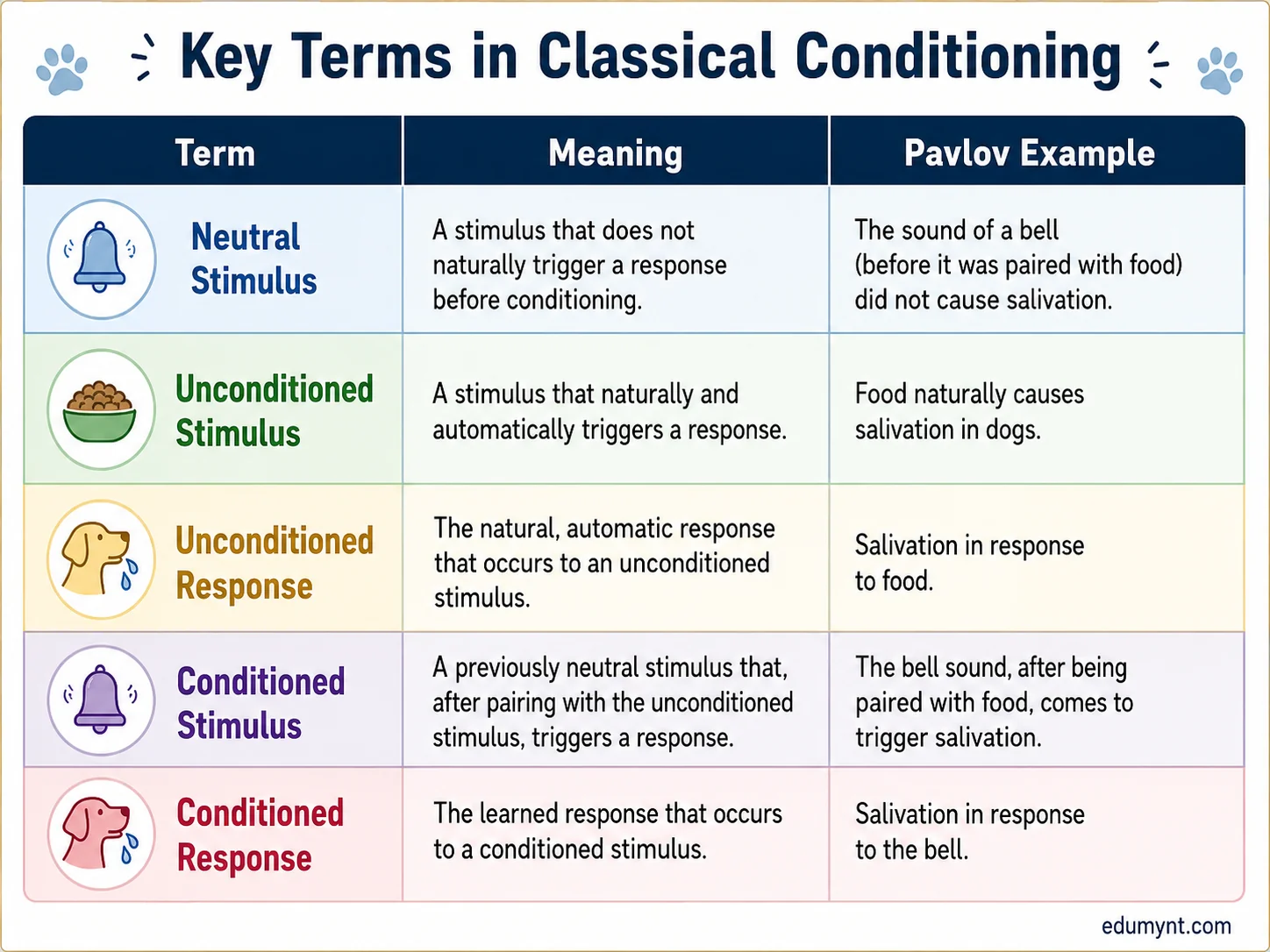
Classical conditioning becomes much easier once you understand its five main terms.
| Term | Meaning | Pavlov Example |
|---|---|---|
| Neutral Stimulus | A stimulus that does not naturally produce the target response before conditioning | Bell before learning |
| Unconditioned Stimulus | A stimulus that naturally produces a response | Food |
| Unconditioned Response | A natural, automatic response | Salivation to food |
| Conditioned Stimulus | A previously neutral stimulus that produces a learned response after association | Bell after learning |
| Conditioned Response | The learned response to the conditioned stimulus | Salivation to bell |
A neutral stimulus is something that does not naturally cause the target response.
In Pavlov’s experiment, the bell was originally neutral because it did not naturally make the dog salivate.
Everyday example: A dentist’s waiting room may be neutral for a child before they ever have an uncomfortable dental experience.
An unconditioned stimulus naturally triggers a response without learning.
In Pavlov’s experiment, food was the unconditioned stimulus because dogs naturally salivate when food is presented.
Everyday example: A very loud noise naturally causes a person to startle.
An unconditioned response is the natural, automatic reaction to the unconditioned stimulus.
In Pavlov’s experiment, salivating to food was the unconditioned response.
Everyday example: Jumping when you hear a sudden loud sound.
A conditioned stimulus is a once-neutral stimulus that produces a learned response after being paired with an unconditioned stimulus.
In Pavlov’s experiment, the bell became the conditioned stimulus.
Everyday example: A hospital smell may become a conditioned stimulus if it has been associated with pain, fear, or illness.
A conditioned response is the learned reaction to the conditioned stimulus.
In Pavlov’s experiment, salivating to the bell was the conditioned response.
Everyday example: Feeling anxious when smelling a hospital-like disinfectant because it reminds you of a previous unpleasant medical experience.
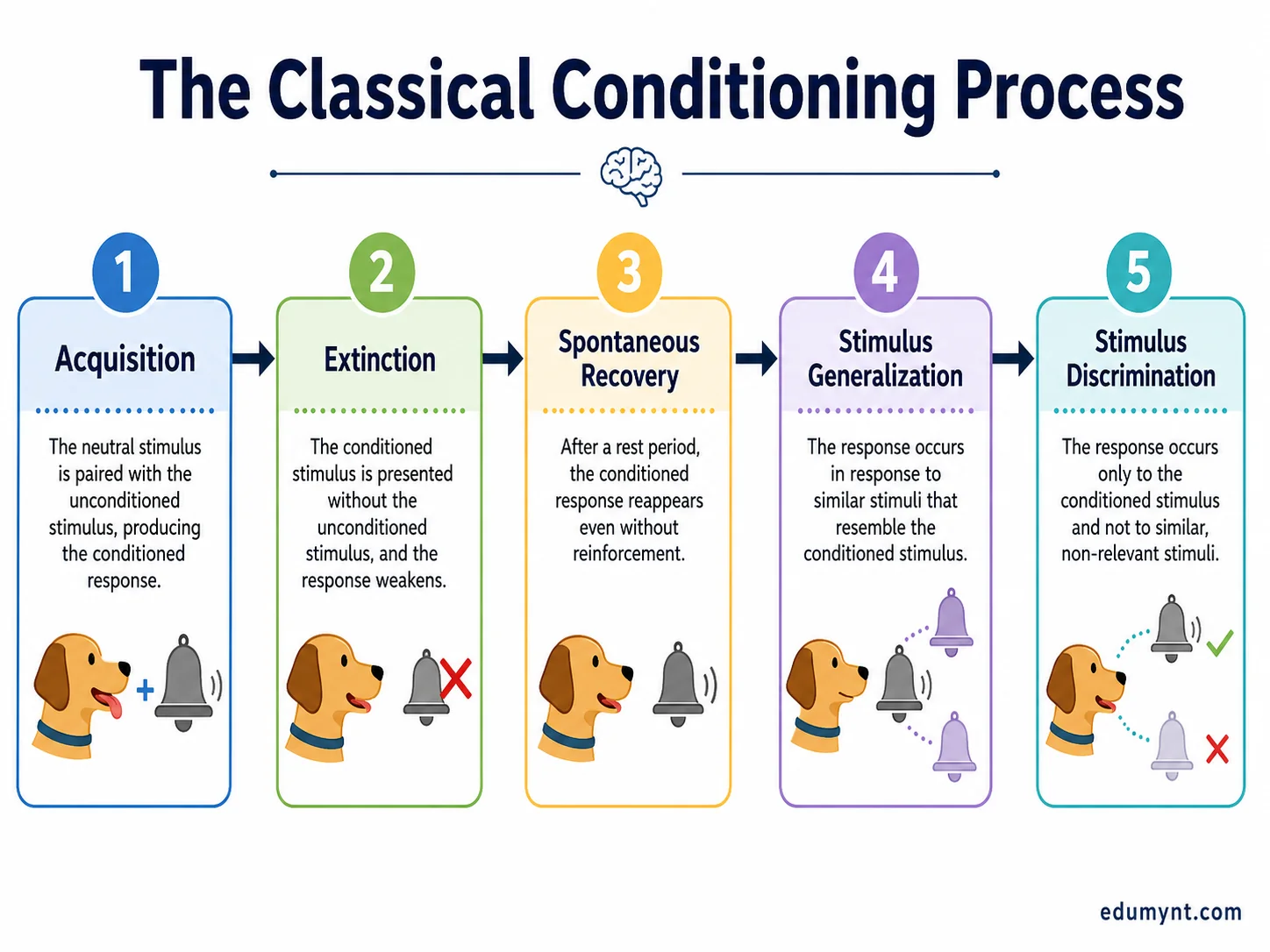
Classical conditioning is not just one moment of learning. It often includes several important processes.
Acquisition is the first stage of learning.
This is when the neutral stimulus and unconditioned stimulus are paired together often enough for an association to form.
Example:
A child eats popcorn every time they watch a fun movie. Over time, the smell of popcorn may make the child feel excited even before the movie starts.
Extinction happens when the conditioned stimulus is repeatedly presented without the unconditioned stimulus, causing the conditioned response to weaken.
Example:
If a bell rings many times but food never appears, Pavlov’s dog may eventually stop salivating to the bell.
Everyday example:
If a student used to feel nervous when hearing a school bell because it meant a strict test was about to begin, but the bell later becomes associated with normal class transitions, the nervous response may fade.
Spontaneous recovery is the return of a previously weakened conditioned response after a pause.
Example:
A dog stops salivating to a bell after extinction. Later, after some time has passed, the bell may briefly cause salivation again.
This shows that extinction does not always erase learning completely. Instead, the learned association may become weaker or less active.
Stimulus generalization happens when similar stimuli produce the same conditioned response.
Example:
If a child is bitten by a large white dog, they may later feel afraid of other white dogs, large dogs, or even dogs in general.
The fear spreads from the original stimulus to similar ones.
Stimulus discrimination happens when a person or animal learns to respond differently to similar stimuli.
Example:
A child who was bitten by one aggressive dog may later learn that calm, friendly dogs are safe. They may still feel nervous around dogs that bark aggressively but feel comfortable around gentle pets.
Discrimination helps people respond more accurately instead of reacting the same way to everything that seems similar.
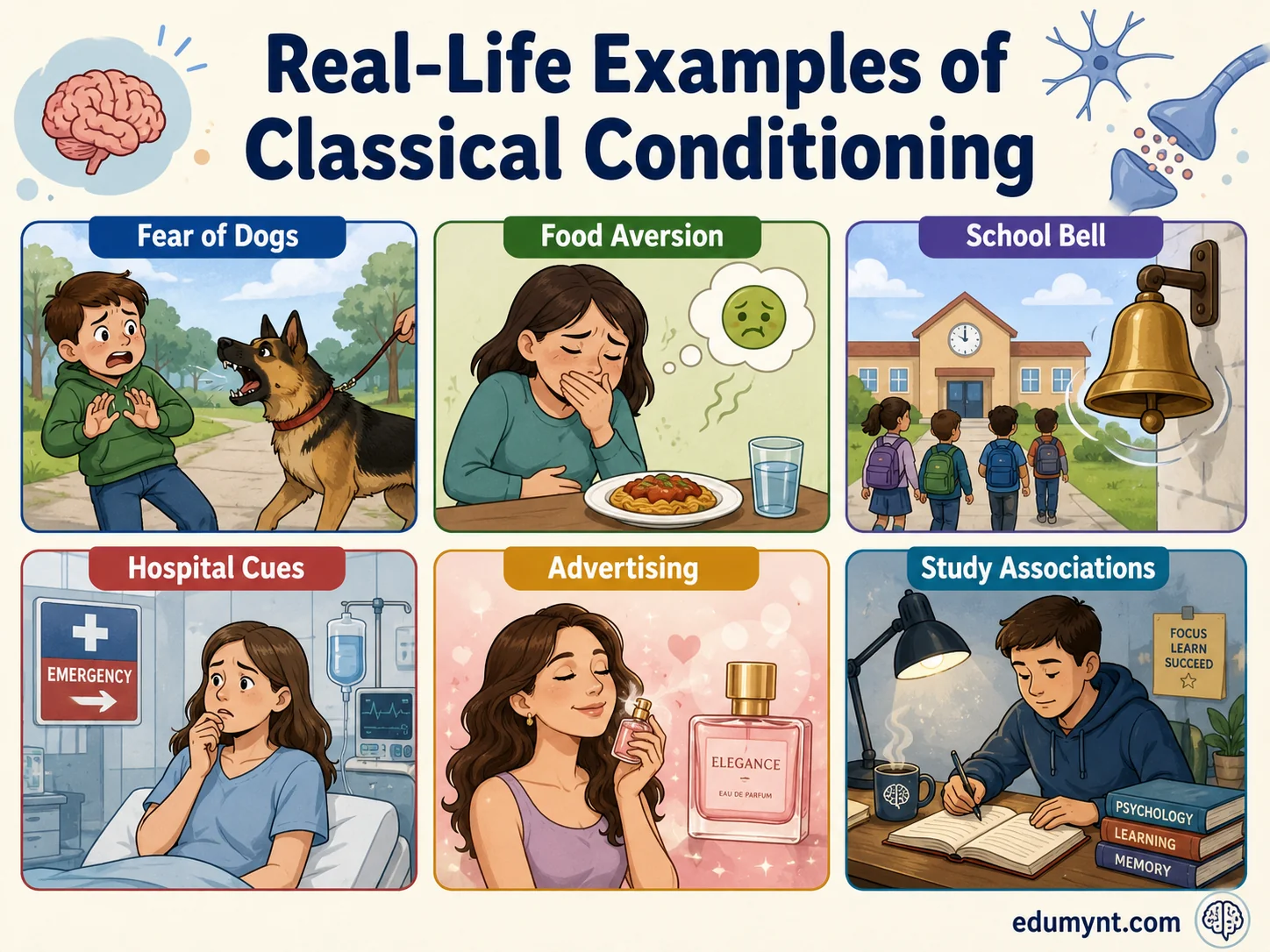
Classical conditioning is not limited to laboratories. It appears in everyday life more often than people realize.
A person who is bitten by a dog may later feel afraid when they see dogs.
In this example:
- Dog bite = unconditioned stimulus
- Pain and fear = unconditioned response
- Dog = conditioned stimulus
- Fear when seeing dogs later = conditioned response
This is one reason some fears can develop quickly after a single intense experience.
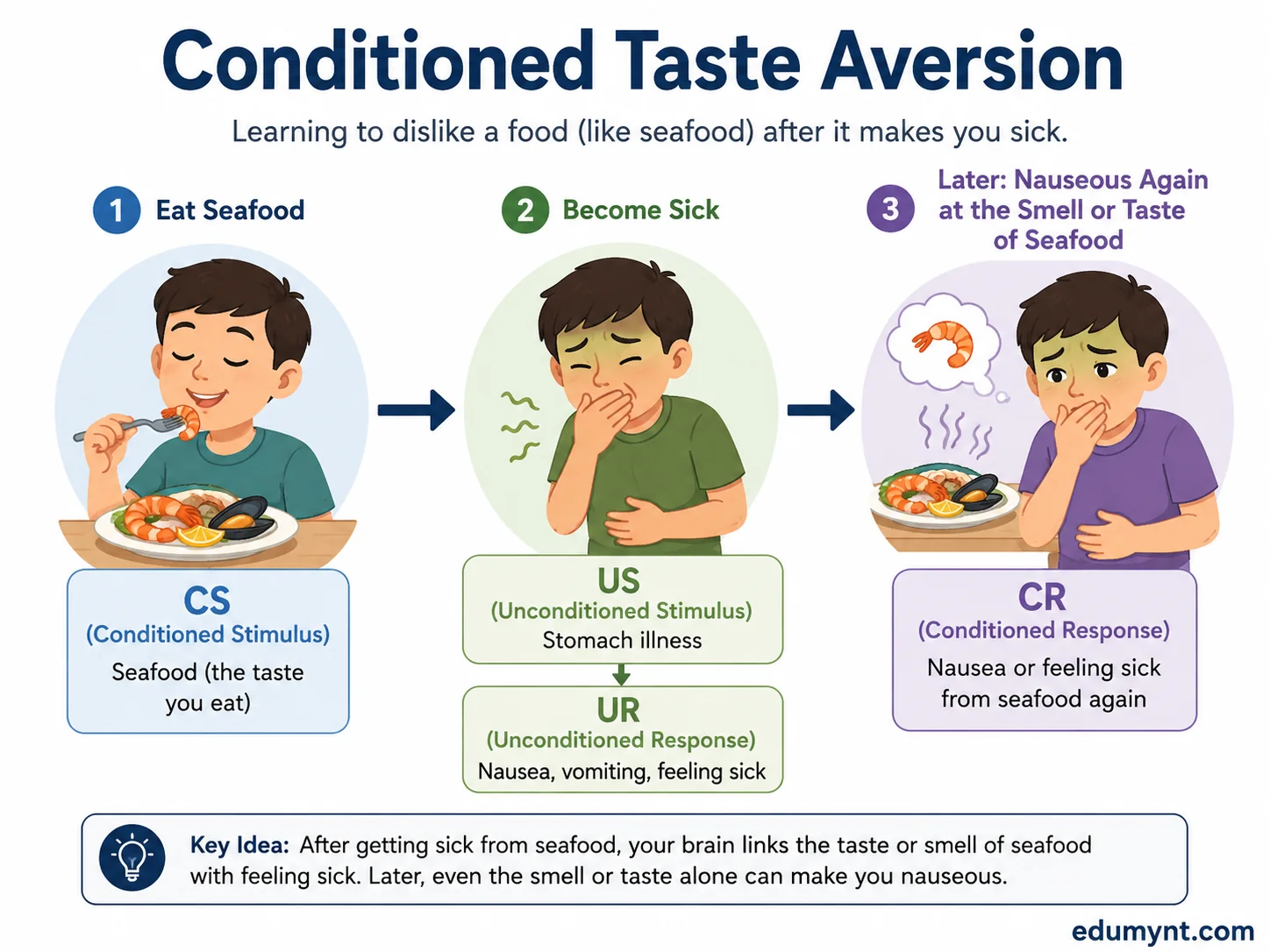
Food aversion is a powerful example of classical conditioning.
Suppose someone eats seafood and later becomes very sick. Even if the seafood did not actually cause the illness, the person may feel nauseous the next time they smell or see seafood.
In this example:
- Illness = unconditioned stimulus
- Nausea = unconditioned response
- Seafood taste or smell = conditioned stimulus
- Nausea when encountering seafood later = conditioned response
Taste aversion is especially interesting because it can sometimes form after just one experience.
A school bell can become a conditioned stimulus.
At first, the bell is just a sound. But after repeated association with class changes, lunch, dismissal, or exams, students may automatically pack their bags, feel hungry, or become alert when they hear it.
The bell itself does not create hunger or movement. The meaning comes from repeated association.
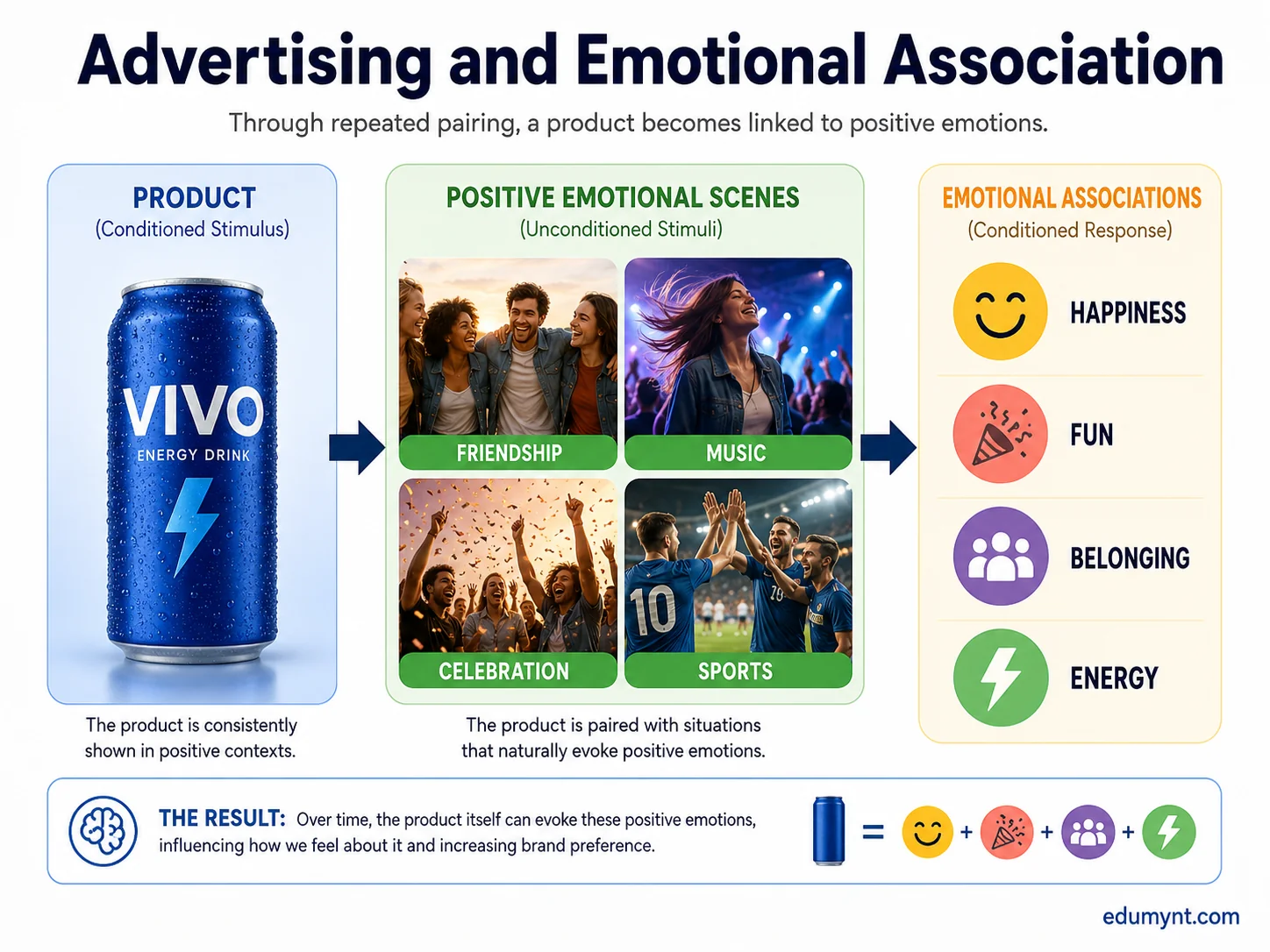
Advertisers often use classical conditioning by pairing products with positive emotions.
For example, a commercial may show a soft drink alongside friendship, music, celebration, and happiness. Over time, viewers may associate the product with those emotions.
The product becomes linked with a feeling.
This does not mean advertising controls people completely. But it can shape emotional associations and brand preferences.
A person who has gone through painful medical procedures may later feel anxious when seeing hospital lights, smelling disinfectant, or hearing medical equipment.
The hospital cues become associated with fear or discomfort.
This helps explain why some people feel nervous even before a medical procedure begins.
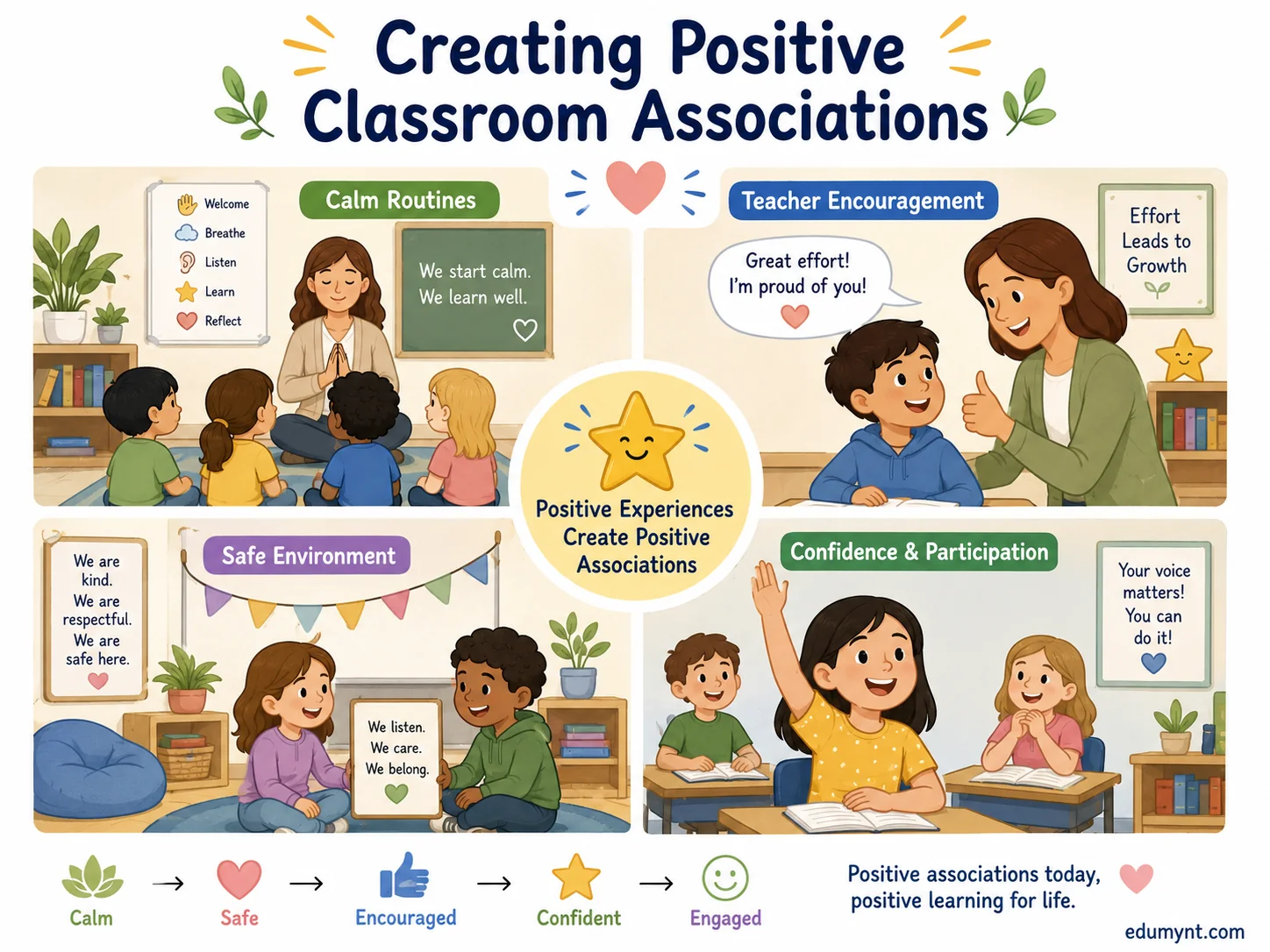
Classical conditioning can also support positive learning environments.
For example:
- A teacher starts each class with a calm routine.
- Students receive encouragement during difficult tasks.
- The classroom becomes associated with safety and confidence.
Over time, students may feel more comfortable participating because the environment has been repeatedly paired with positive experiences.
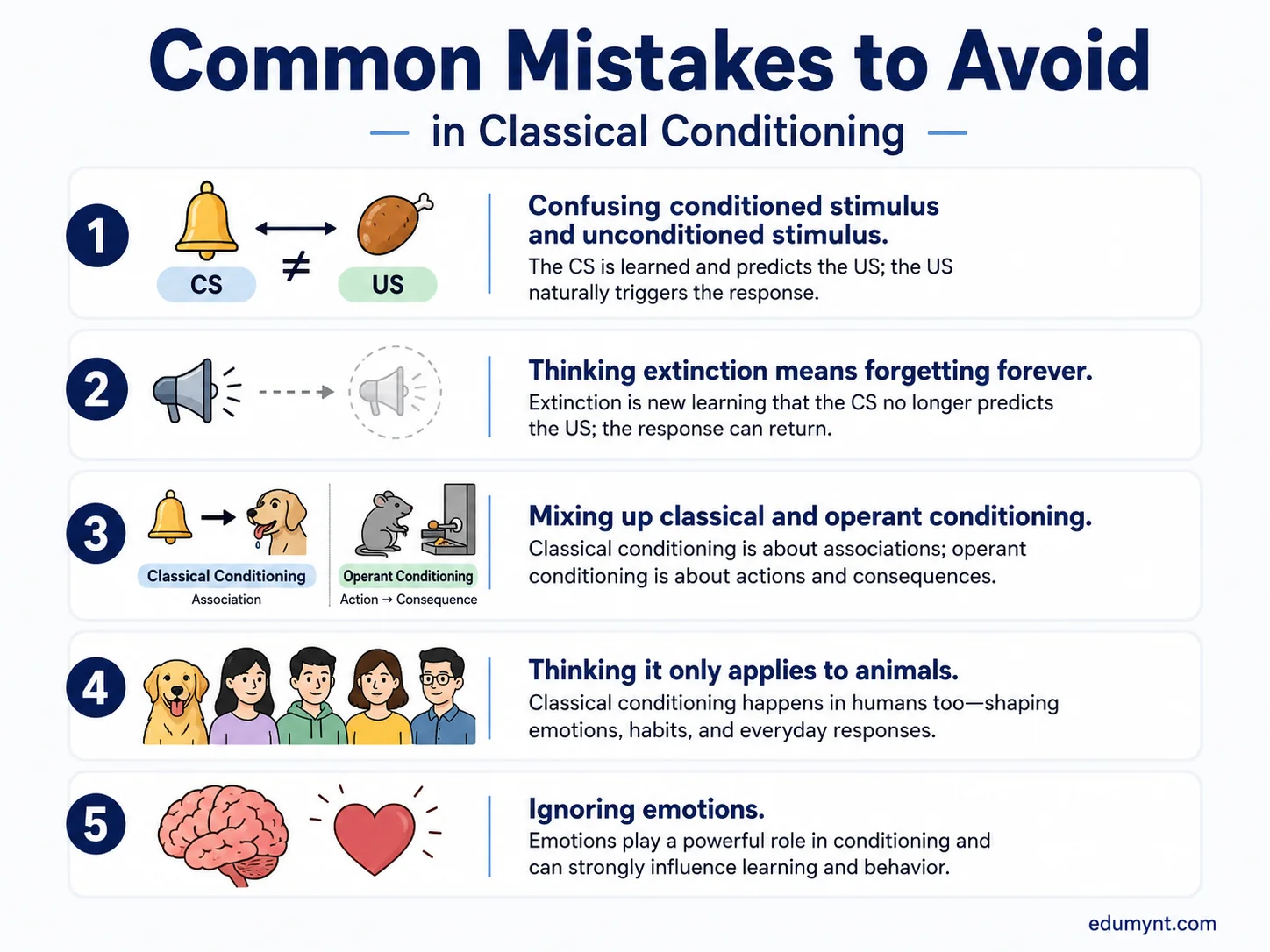
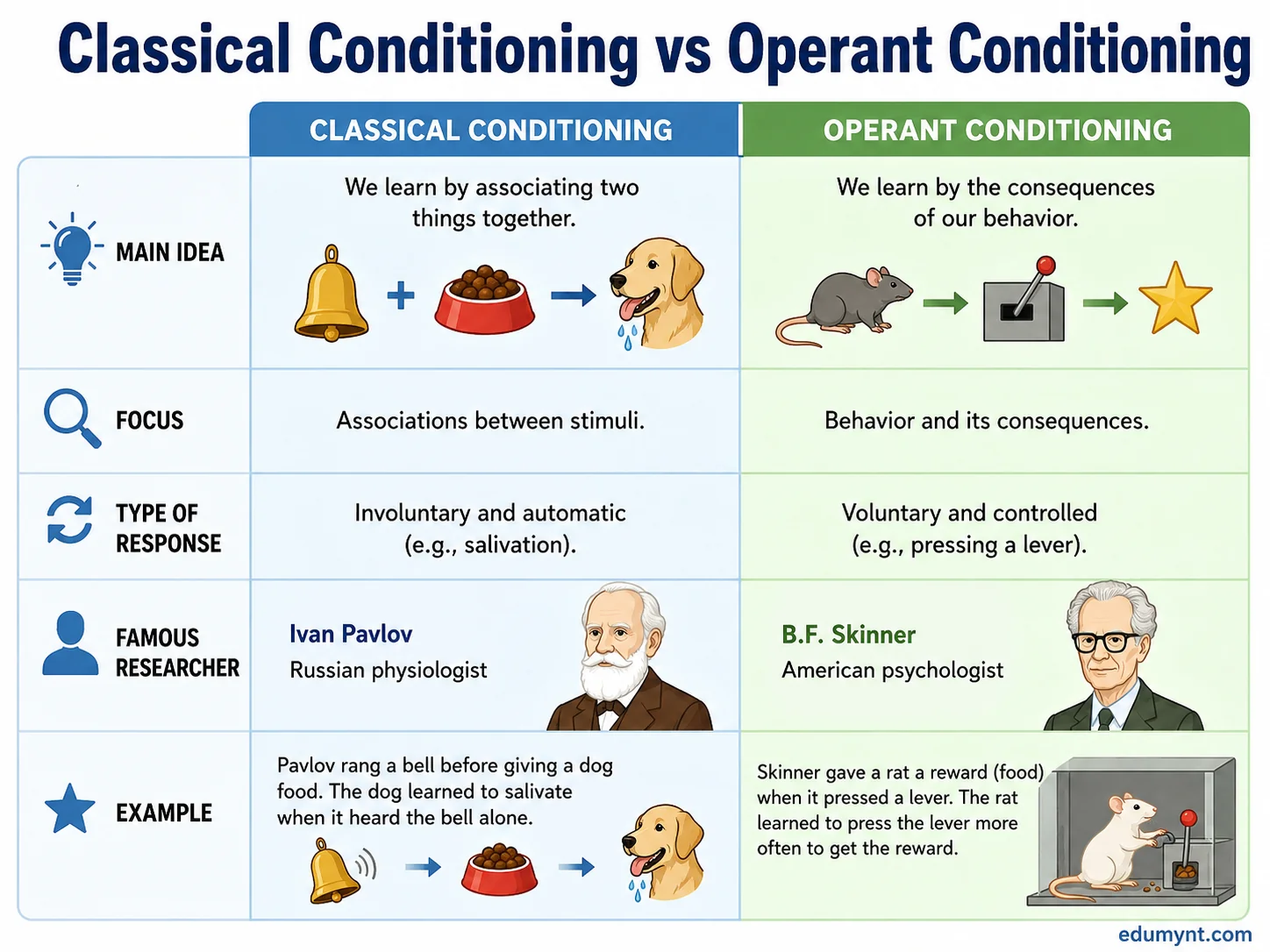
Students often confuse classical conditioning with operant conditioning. Both are forms of learning, but they work differently.
Classical conditioning is learning by association between stimuli.
Operant conditioning is learning through consequences, such as rewards or punishments.
| Feature | Classical Conditioning | Operant Conditioning |
|---|---|---|
| Main idea | Learning by association | Learning through consequences |
| Focus | Stimuli before the response | Consequences after behavior |
| Type of response | Often automatic or emotional | Often voluntary behavior |
| Famous researcher | Ivan Pavlov | B. F. Skinner |
| Example | Bell predicts food, dog salivates | Student studies more after earning praise |
Classical conditioning asks:
“What stimulus triggers the response?”
Operant conditioning asks:
“What consequence changes the behavior?”
Example:
A student feels nervous when seeing a test paper because tests have been paired with stress. That is classical conditioning.
A student studies harder because good grades lead to praise or rewards. That is operant conditioning.
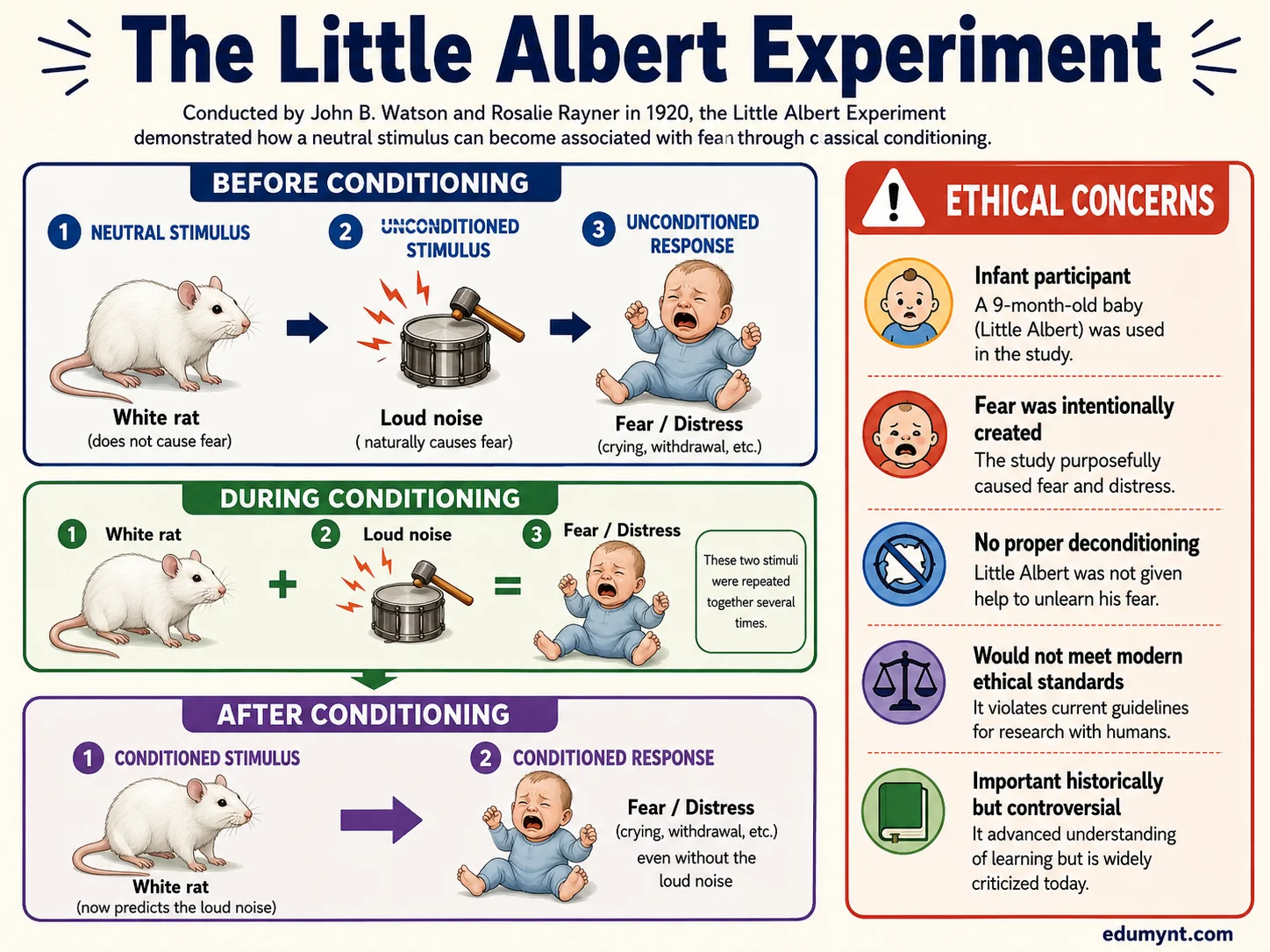
The Little Albert experiment is another famous example connected to classical conditioning.
In 1920, John B. Watson and Rosalie Rayner attempted to show that fear could be conditioned in a human infant. A baby known as “Little Albert” was shown a white rat. At first, the child did not appear afraid of it. Then the researchers paired the rat with a loud frightening noise.
After repeated pairings, Albert showed fear when he saw the rat. His fear also appeared to generalize to similar furry objects.
The Little Albert experiment is controversial for several reasons:
- The participant was an infant.
- The researchers intentionally created fear.
- The fear was not properly removed afterward.
- The methods would not meet modern ethical standards.
- Later researchers have questioned how strong and clear the evidence actually was.
The study is historically important, but it should be discussed carefully. It is not a model for how research should be conducted today.
Classical conditioning matters because it helps explain real behavior in real settings.
Teachers can use the principles of association to build a positive learning atmosphere.
For example:
- Pair difficult tasks with encouragement.
- Use predictable routines to reduce anxiety.
- Create positive associations with reading, writing, math, or public speaking.
- Avoid repeatedly pairing schoolwork with embarrassment or fear.
A student who feels safe and supported is more likely to engage with learning.
Parents can use classical conditioning to create helpful associations.
For example:
- A bedtime story can become a cue for calmness.
- A clean-up song can signal that playtime is ending.
- A warm goodbye routine can reduce separation anxiety.
The goal is not to manipulate children. The goal is to create predictable, emotionally safe patterns.
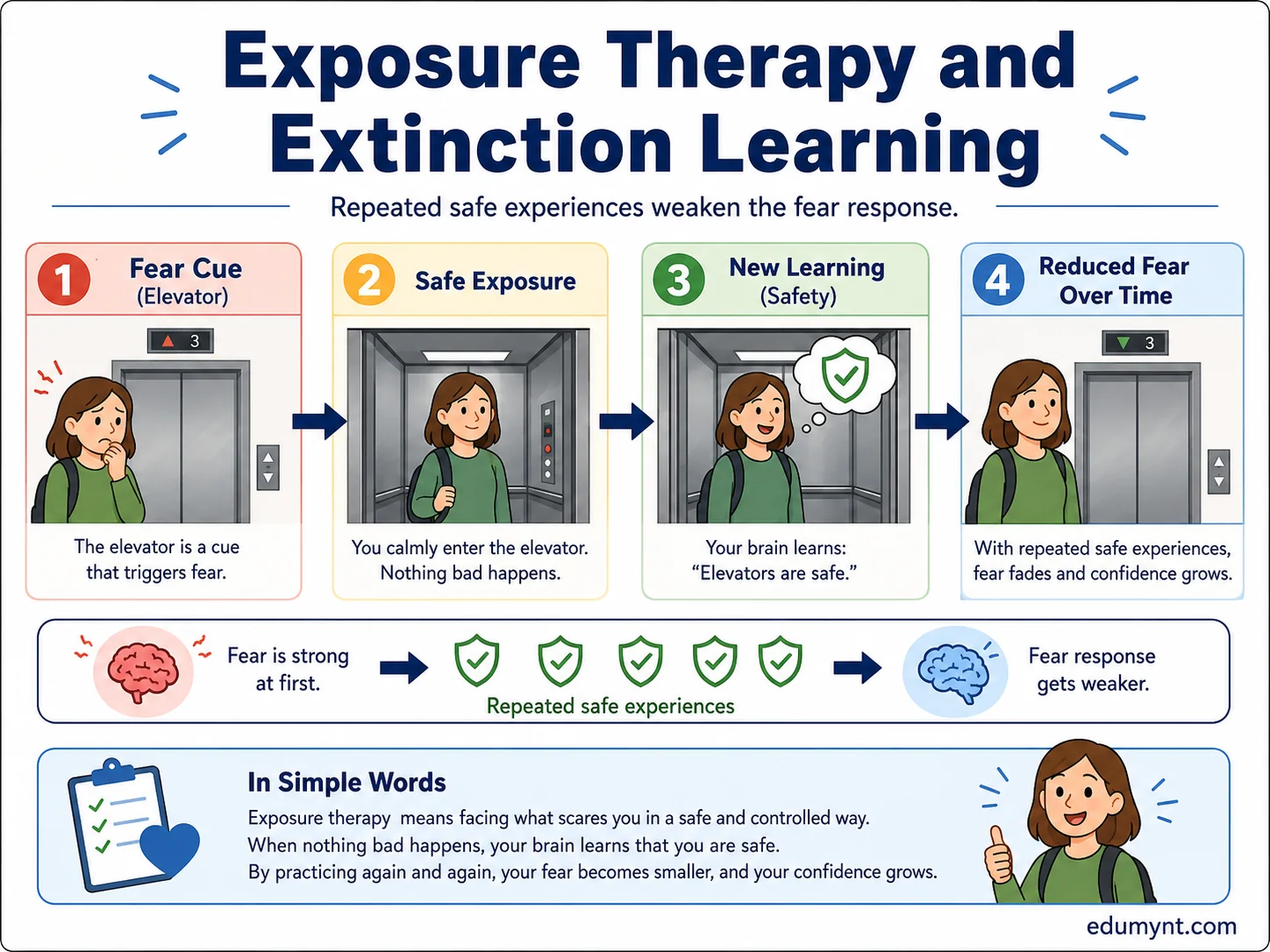
Classical conditioning helps explain how fears can develop, but it also helps explain how they can be reduced.
In exposure-based therapies, people gradually and safely face feared situations or objects. Over time, the feared stimulus may become associated with safety rather than danger.
For example, someone with a fear of elevators may gradually practice being near elevators, stepping inside, and riding short distances in a controlled way.
This process can help weaken the fear response.
Brands often pair products with emotions, lifestyles, or identities.
Examples:
- A perfume paired with romance
- A sports drink paired with energy and success
- A car paired with freedom and adventure
- A snack paired with friendship and fun
The repeated pairing can influence how people feel about the product.
Classical conditioning can affect health behaviors.
For example:
- A person may feel nauseous before chemotherapy because the clinic environment has become associated with treatment side effects.
- Someone may crave coffee when they smell roasted beans.
- A person may feel calm when using the same breathing exercise in the same quiet space each day.
Understanding these associations can help people build healthier routines.
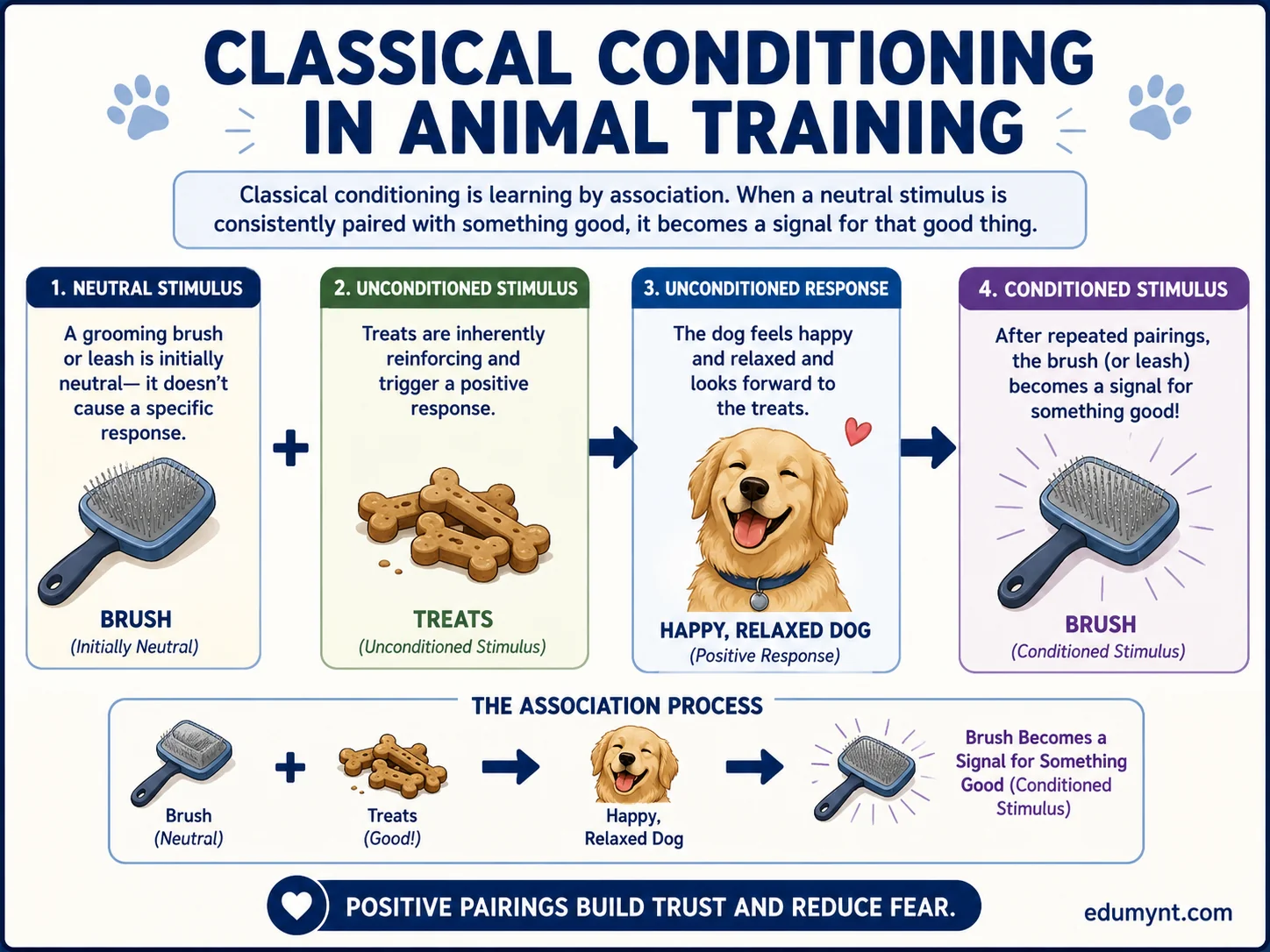
Animal trainers often consider classical conditioning when helping animals feel safe around people, objects, or environments.
For example, a dog may learn to associate a carrier, leash, or grooming brush with treats and calm handling.
This can reduce fear and build trust.
Classical conditioning is simple once understood, but the terms can be confusing at first.
The unconditioned stimulus naturally causes the response.
The conditioned stimulus only causes the response after learning.
In Pavlov’s experiment:
- Food is the unconditioned stimulus.
- Bell is the conditioned stimulus.
Extinction means the conditioned response weakens. It does not always mean the original learning is completely erased.
That is why spontaneous recovery can happen.
Remember:
- Classical conditioning is about associations between stimuli.
- Operant conditioning is about consequences after behavior.
Pavlov studied dogs, but classical conditioning also applies to humans.
It can influence fears, preferences, cravings, emotions, and routines.
Classical conditioning is not only about physical responses like salivation. It can also involve emotional responses such as fear, comfort, excitement, disgust, or anxiety.
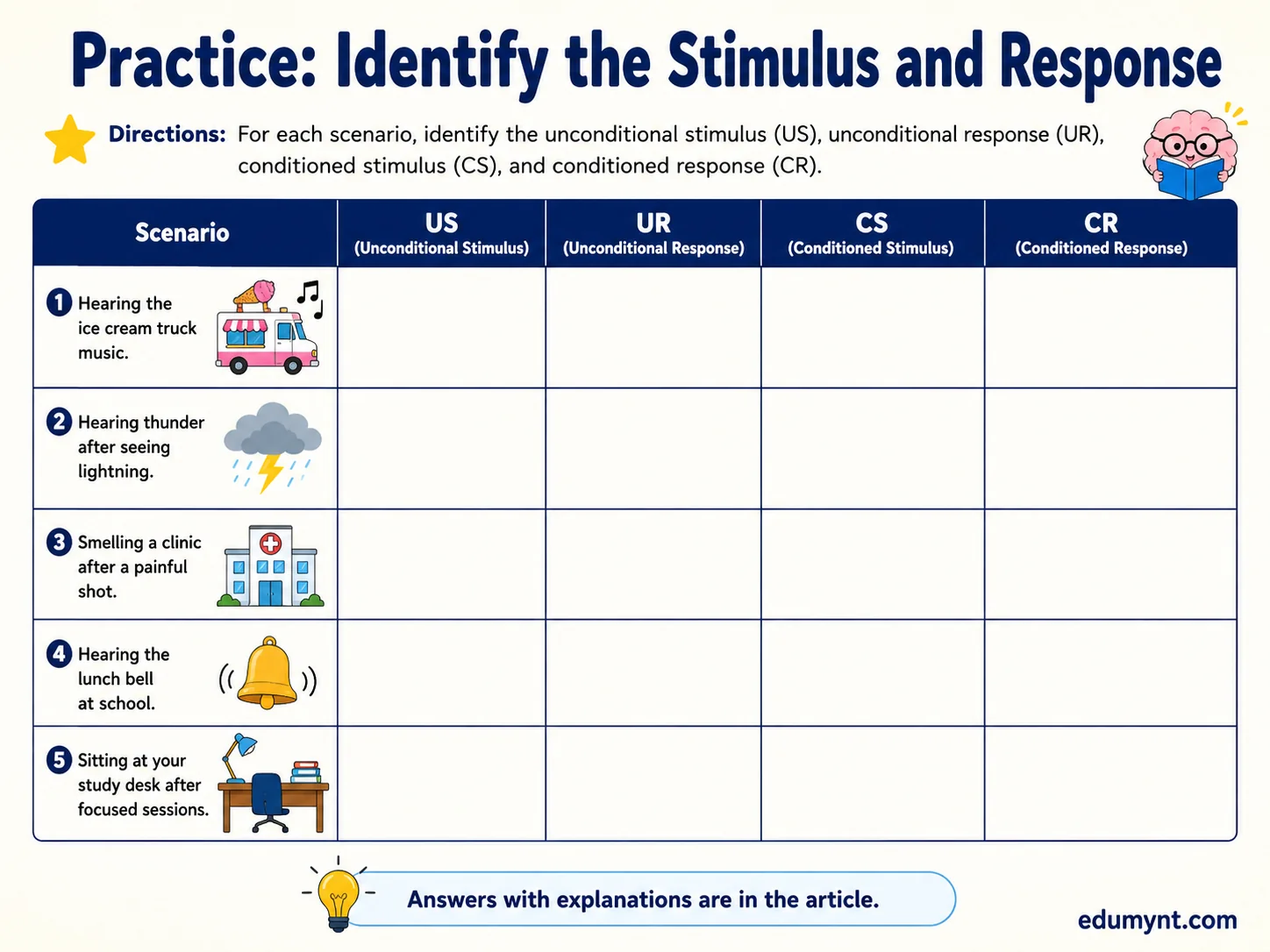
Try these examples. Identify the unconditioned stimulus, unconditioned response, conditioned stimulus, and conditioned response.
Example 1: Every time you open a certain food delivery app, you hear a specific sound. After weeks of ordering, you start feeling hungry just hearing that sound.
- Unconditioned stimulus: Food arriving
- Unconditioned response: Feeling hungry / excited about food
- Conditioned stimulus: App notification sound
- Conditioned response: Feeling hungry when hearing the sound
Example 2: A child receives a painful injection at the doctor’s office. Later, the child cries when seeing the doctor’s white coat.
- Unconditioned stimulus: Injection
- Unconditioned response: Pain and crying
- Conditioned stimulus: White coat
- Conditioned response: Crying when seeing the white coat
Example 3: A person always listens to the same playlist while exercising. Later, hearing that playlist makes them feel energized even without exercising.
- Unconditioned stimulus: Exercise
- Unconditioned response: Increased energy and heart rate
- Conditioned stimulus: Playlist
- Conditioned response: Feeling energized when hearing the playlist
Classical conditioning is one of the most foundational concepts in psychology. It explains how we learn through association, how fears develop, how preferences form, and how environments shape our emotional responses.
The key ideas to remember:
- Neutral stimulus becomes a conditioned stimulus through repeated pairing with an unconditioned stimulus.
- The conditioned response is the learned reaction.
- Acquisition is the initial learning; extinction is the weakening of the response.
- Spontaneous recovery shows that extinction does not erase learning.
- Generalization spreads the response to similar stimuli; discrimination helps distinguish between them.
- Classical conditioning applies to humans and animals, in laboratories and everyday life.
Understanding classical conditioning gives you a powerful lens for understanding human behavior, emotional reactions, and learning patterns.